

Learn about the Event Venue industry and find information on how to start your own event venue business. Don’t forget you can receive free or low-cost training and free professional business advice, from your local Small Business Development Center!
View our related business reports here: Event Planning Business, Recreation & Leisure Industry Resources, Travel & Tourism Industry Resources
Get a Event Venue Business Plan template on our Business Plan Page
Event Venue Business Forecast
The event venue industry is experiencing a strong recovery and rapid expansion after facing years of industry headwinds. The broader U.S. commercial real estate market is currently defined as having stable interest rates, rising transaction activity, and improved capital liquidity. These conditions influence operations and investment decisions in the event center industry. According to the J.P Morgan Commercial Real Estate Outlook, all major real estate sectors remain steady, suggesting a relatively stable environment for venue owners. Although the industry continues to face emerging issues such as climate-related costs pressures and fluctuating interest rates, demand for event venues remains consistently high.
The event venue industry supports a wide range of gatherings, including corporate events, live concerts, weddings, and more. Interest in live entertainment is rising, although this growth may face limitations as elevated ticket prices make some events less accessible to the average attendee. Across all event types, in‑person experiences continue to hold strong appeal. Attendees value the ability to connect, network, and engage in ways that virtual formats can’t fully replicate. In response, venues are investing in upgraded technology, flexible layouts, and hybrid‑event capabilities to meet evolving expectations and deliver more immersive experiences. As each event category expands, they collectively strengthen the market for event centers. Owners can capitalize on these trends by marketing strategically to an event planning business and positioning their venues as ideal locations for these occasions.
Here are some additional business resources specific to the industry:
- Professional Convention Management Association – Research & Resources
- Events Council – Industry Resources
- International Association of Venue Managers – Resources
- Meeting Professionals International – Planner Resources
Event Venue Business Overview & Trends
NAICS Code: 531120, 711310; SIC Code: 6512
Event venues play a significant role in the service sector. The event venue market continues to grow, with independent live venues, festivals, and promoters contributing $86.2 billion directly to the U.S. economy according to the National Independent Venue Association.
This Commercial Real Estate Brokerage & Management summary from First Research includes the event center market, which also sells a full version of this report.
- “Companies in this industry act as agents in the buying, leasing and selling of commercial real estate, in addition to managing nonresidential properties for owners. Major companies include CBRE, Cushman & Wakefield, Jones Lang LaSalle, and Newmark (all US-based), as well as Colliers International (Canada), Countrywide and Savills (both in the UK), and Mitsui Fudosan (Japan).
- Global commercial property sales, which drive demand for this industry, have been rising steadily. The global commercial real estate brokerage and management market generated about $4.5 trillion in 2024, and is expected to reach nearly $9.5 trillion by 2034, according to Fact.MR. The increase is driven by the urban population, rise in commercial construction buildings, and surge in government initiatives for real estate investments.
- The US commercial real estate brokerage and management industry includes about 140,000 establishments (single-location companies and units of multi-location companies) with combined annual revenue of about $140 billion.
- The industry includes sales and leasing brokers and agents for nonresidential property, as well as property managers. Many companies combine these functions. Brokers and property managers also are covered individually in separate profiles. Owners of commercial property who perform their own leasing and property management aren’t included in this industry. Commercial real estate financing is not included in this industry.
- Competitive Landscape: Demand, which is driven by the volume of commercial real estate transactions, is heavily influenced by real estate vacancy rates.”
Event Venue Technology
Technology is an increasingly vital component utilized in the event venue industry. Many event venue owners are adopting smarter, streamlined tools to support operations. From AI-driven automation to 3D spatial planning, event center managers are increasingly turning to integrated platforms that improve workflow and enhance the event experience. Here is information on technology usage in the event venue industry:
- Event Technology Trends – rising event technology transforming venues
- Key Trends – explores use of AI and other technologies in event venue management
- AI Use in Building Management – covers how AI can be utilized for building management
For additional information on technology, visit our AI for Small Business Guide.
Event Venue Customer Demographics
Major customer segments for Concert & Event Promotion are reported by IBISWorld which offers a full version of their report for purchase here.
- The Concert & Event Promotion market is segmented by industry revenue.
- Attendees aged 25 to 54 generate the largest share of industry revenue at 55.4%. Their higher discretionary income enables them to attend more live music concerts and sporting events, as well as spend on concessions and venue‑sold merchandise
- Event attendees aged 65 and older make up 17.7% of industry revenue. They prefer theatrical performances that take place earlier in the day to accommodate their routines and accessibility needs. Event venue managers can appeal to seniors by offering discounts, and senior-friendly options to maximize their impact on revenue.
- Attendees aged 55 to 64 account for 16.7% of industry revenue. They have higher disposable income but attend live events less frequently. The consumers in this age range that do attend live events frequently support sports events and opt for any exclusive perks and packages.
- Attendees aged 18 to 24 account for the smallest percentage of industry revenue at 10.2%. Although this age range is characterized by its willingness to invest in experiences such as concerts, sporting events, and festivals, they are held back by limited disposable income.
Additional information on event venue demographics can be found in a variety of trade associations and publications, including:
- Tourism Impact on Live Music Events – Advertising Week
- The Future Of Festivals – Forbes
- Social media impact on live events – Marketing Dive
- State of US Sports Viewing – S&P Global
- Gen Z Live Music Event Attendance – Spotlight
Event Venue Startup Costs
Establishing an event venue requires an understanding of the startup costs involved in order to develop a sound financial plan. Whether you’re purchasing an existing facility or selecting a site to build your own, there are many important costs to consider.
According to a cost breakdown reported by Profitable Venture, event venue start up costs are as follows:
- “Estimated Cost Breakdown For Starting An Event Venue
- Property Purchase or Lease:
- Down Payment or Lease Deposit: $100,000 (Depending on location and property size)
- Renovations and Improvements:
- Building Renovations: $50,000 (Updates to meet code, aesthetic improvements, etc.)
- Landscaping: $15,000 (Outdoor event spaces, gardens, etc.)
- Furnishings and Equipment:
- Tables, Chairs, and Decor: $20,000
- Sound and Lighting Equipment: $25,000
- Kitchen Equipment (if applicable): $20,000
- Permits for Event and Business Licenses: $5,000
- Total Estimated Cost – $250,000”
- Property Purchase or Lease:
Additional event venue startup cost information can be found at:
- How Much Does It Cost to Start a Wedding Venue Business from Profitable Venture
- “Purchasing, Rent, or Lease of Property
- The Required Renovations and Modifications
- The Cost of Securing the Needed Licenses and Permits
- The Cost of Staffing
- The Cost of Furnishings and Supplies
- The Cost of Insurance Policy Covers
- The Cost of Marketing and Promoting the Wedding Venue
- Depending on how big you want to announce your presence in the market, you should have a budget estimate of $1,000 to $3,000 or more.”
Event Venue Business Plans
The following are sample event venue business plans for reference. For additional business plan samples, visit our Business Plans Guide.
- Event Venue Business Plan Template – Business Plan Template (1)
- Banquet Hall Business Plan Template – Growthink
- Wedding Venue Business Plan Template – Business Plan Template (2)
- Wedding Venue Business Plan – LivePlan
- Event Center Business Plan – Profitable Venture (1)
- Wedding Venue Business Plan – Profitable Venture (2)
- Music Venue Business Plan – Profitable Venture (3)
- Banquet Hall Rental Business Plan – Profitable Venture (4)
- Music Festival Business Plan – The Finance Resource
Event Venue Business Associations
Trade associations often are excellent sources of information on an industry. Here are some relevant event venue industry associations:
- National Independent Venue Association
- Event Service Professionals Association
- Professional Convention Management Association
- National Association for Catering & Events
- American Association of Certified Wedding Planners
- Corporate Event Marketing Association
- International Association of Exhibitions & Events
- International Congress and Convention Association
- Meeting Professionals International
- International Association of Venue Managers
Event Venue Business Regulations
The section is intended to provide a general awareness of event venue industry regulations and agencies to consider when starting your business. Check with your state and municipality for rules and regulations that may impact the businesses in your area.
Although there is no industry-specific regulation requirement for event venues, it is important to ensure events are compliant with local laws and regulations such as alcohol licensing, accessibility, capacity limitations, and smoking regulations. Check with your state and municipality for rules and regulations that may impact business operations in your area. Some voluntary certifications are available for event venue managers through industry associations:
Event Venue Business Publications & Resources
- Venue Report
- Venue Professional Magazine
- Venue Magazines
- Meetings & Conventions
- Event Marketer Magazine
- Event Industry News
- Successful Meetings
- Brides Magazine
- The Knot
- Cater+ Event
- Smart Meetings
- PCMA Convene Magazine
For resources to help market your event venue start up, visit our Digital Marketing Guide, Social Media Marketing Guide, and our Website Design Guide.
Event Venue Employment Trends
Understanding employment trends within the service sector is essential when opening an event venue business. These businesses depend on a variety of specialized support roles to operate smoothly, including venue managers, AV technicians, and staff for maintenance. The following are insights from the Bureau of Labor Statistics Occupational Outlook Handbook into Meeting, Convention, and Event Planners. A more specific breakdown of other business and financial occupations is available from the Bureau of Labor Statistics.
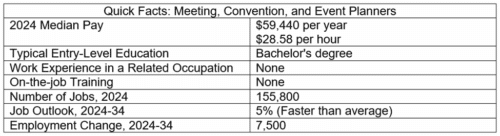
- “Pay: The median annual wage for meeting, convention, and event planners was $59,440 in May 2024.
- Work Environment: Meeting, convention, and event planners work in their offices and onsite at hotels or conference centers. They often travel to attend events and visit meeting sites. During meetings or conventions, planners may work many more hours than usual.
- Job Outlook: Meeting, convention, and event planners spend time in their offices and at event locations, such as hotels and convention centers. They may travel regularly to attend the events they organize and to visit meeting sites. The work of meeting, convention, and event planners can be fast paced and demanding. Planners oversee many aspects of an event at the same time and face numerous deadlines, and they may coordinate multiple meetings or events at the same time. Employment of meeting, convention, and event planners is projected to grow 5 percent from 2024 to 2034, faster than the average for all occupations. About 15,500 openings for meeting, convention, and event planners are projected each year, on average, over the decade. Many of those openings are expected to result from the need to replace workers who transfer to different occupations or exit the labor force, such as to retire.”
Additional Small Business Resources
Already in business or thinking about starting your own small business? Check out our various small business resources:
- View more business reports here: Small Business Snapshots
- View small business help topics here: Small Business Information Center
- View industry-specific research here: Market Research Links
- View business plans samples here: Sample Business Plans
Remember, you can also receive free professional business advice and free or low-cost business training from your local Small Business Development Center!
Photo by Ibrahim Boran on Unsplash