

Learn about the Event Planning Industry and find information on how to open your own event planning business. Don’t forget you can receive free or low-cost training and free professional business advice, from your local Small Business Development Center!
View our related business reports here: Event Venue Business, Recreation & Leisure Industry Resources, Travel & Tourism Industry Resources
Get a Event Planning Business Plan template on our Business Plans page.
Event Planning Industry Business Forecast
The event and party planning industry is steadily recovering from past disruptions, supported by the growing use of technology and the strong return of in-person events. Most event professionals feel confident about the industries’ direction, and many expect their budgets to increase as demand rises. However, even with this positive outlook, event planners still face a range of challenges including inflation-related costs increases, and staffing shortages. To overcome these obstacles, event planners are increasingly replying on more advanced operational strategies that improve efficiency and reduce costs. These include structured workflows and centralized communication systems to help support seamless event execution.
Looking ahead, event planners are preparing to respond to emerging industry trends and shifting consumer expectations. While many planners are integrating AI tools and digital platforms to streamline their operations, attendees continue to show a strong preference for in‑person events despite the costs and are even willing to travel to participate. As a result, the industry has evolved significantly since past disruptions, giving rise to new models of growth and engagement. Meanwhile, attendees consistently rank immersive experiences, creative design, and high‑quality entertainment as the most important elements of a successful event. In turn, the growing emphasis on experience requires planners to think more strategically about how technology, storytelling, and interactive elements can elevate the overall atmosphere of an event. Therefore, event planners must stay informed on consumer preferences and industry trends to maintain strong attendee engagement. By combining thoughtful experience design with the right technological tools, they can create events that feel both memorable and meaningful.
Here are some additional business resources specific to the industry:
- Wedding Industry Professionals Association – WIPA News
- Professional Convention Management Association – Research & Resources
- Events Industry Council – Industry Insights
- Corporate Event Marketing Association – Case Studies & White Papers
- International Live Events Association – Resources (ileahub.com)
- International Association of Venue Managers – Resources (iavm.org)
Event Planning Industry Overview & Trends
NAICS Codes: 812990, 561920; SIC Codes: 7389, 7299
This trade show and event planning services industry summary is from First Research which also sells a full version of this report.
- “Companies in this industry organize, manage, operate, and promote trade shows, conventions, conferences, and meetings. Major companies include Freeman Company and Pursuit (both based in the US); Hyve Group, Informa Markets, and Reed Exhibitions (all based in the UK); and GL events (France).
- As businesses expand internationally, trade shows and corporate events are attracting attendees from around the world. Emerging markets continue to drive global growth. The global exhibit market is expected to reach $64 billion at nearly 4% compound annual growth rate (CAGR) between 2025 and 2032, according to the Market Data Forecast. The largest market for exhibitions is the US, followed by Germany and China, according to Arizton.
- The US trade show and event planning industry includes about 5,000 establishments (single-location companies or units of multi-location companies) with combined annual revenue of about $16 billion. Organizers of performing arts and sports events are not included in this industry.
- Competitive Landscape: Demand is driven by overall economic activity and corporate profits. The profitability of individual companies depends on managing costs, marketing shows effectively, and retaining key staff members. Large companies have advantages of multiple locations and economies of scale in negotiating labor, transportation, and supply contracts.”
Event Planning Industry Technology
Technology is an increasingly vital component utilized in the event & party planning industry. Many event planners are adopting smarter, streamlined tools to support operations. From contactless check-in to sustainable spatial technology, event planners are increasingly turning to integrated platforms that improve workflow and enhance client experience. Here is information on technology usage in the event & party planning industry:
- Technology Tools and Trends – use of technology in the meeting and event industry
- Opportunities to Use AI – study exploring the use of AI in event planning
- The Tech Shift – how technology is transforming the wedding industry
For additional information on technology, visit our AI for Small Business Guide.
Event Planning Industry Customer Demographics
Major customer segments for party and event planners are reported by IBISWorld, which offers full versions of the reports for purchase.
- The Party & Event Planners industry revenue is segmented by household income and businesses.
- Corporate social events account for 59.4% of the industry revenue. This market includes organizations of all sizes that hire event planners to produce galas, fundraisers, product launches, and company celebrations. Spending on events from this segment increases as profit increases. Economic improvements in recent years have allowed organizations to spend more money on events, which gives event planners growth opportunities and a strong source of revenue.
- Higher household incomes in the fourth and top income quartiles have more discretionary spending and make up 21.4% and 8.1% of industry revenue. This group spends on social events and creates demand for premium event planning services. This consumers segment is less affected by economic fluctuations, creating more opportunities for planners.
- Middle- and lower-income households make up 5.1% and 1.6% of the industry revenue. This market has limited discretionary funds, affecting how much they spend on event-planning services. Many in this group opt for do-it-yourself celebrations. Planners can better reach this segment by offering budget-friendly options that align with spending priorities.
Additional information on event planning demographics can be found in a variety of trade associations and publications, including:
- Defining Your Target Audience – The Event Planner Expo
- Millennial Meeting Planner Sourcing Habits – Cvent
- Engaging New Audiences – National Event Connection
- Industry Trends Report – PCMA Convene
- Live Events Trends & Consumer Buying Behaviors – Provoke Insight
Event Planning Startup Costs
Establishing a event planning business requires an understanding of the startup costs involved in order to develop a sound financial plan.
According to a cost breakdown by Entrepreneur Magazine, event and party planning startup costs are as follows:
- “If you have a knack for planning and parties, this could be the biz for you.
- Startup Costs: $2,000 – $10,000
- Home Based: Can be operated from home.
- Part Time: Can be operated part-time.
- Franchises Available? Yes
- Online Operation? No”
Additional event planning startup cost information can be found at:
- How To Start An Event Planning Business At Home With No Money from Profitable Venture (1)
- “The Amount needed to acquire a suitable Office facility in a business district 6 months (Re – Construction of the facility inclusive) – $40,000.
- The Cost for equipping the office (computers, software applications, printers, fax machines, furniture, telephones, filing cabins, safety gadgets and electronics et al) – $ 5,000
- The Cost of Launching your official website – $600”
- How to Start a Wedding and Event Planning Business from Chron
- “If you are extremely organized and have a strong attention to detail, a career in the wedding and event planning industry might be right for you. According to Entrepreneur, an online source for business information, the startup costs for becoming an event planner are less than $2,000 and it is a business that can be operated from your own home. The event planning business doesn’t require much equipment to get started. As long as you have basic office equipment, such as a computer, printer and word processing software, you can write client proposals and print contracts. Event planners also need to have a cellular phone for their business and be prepared to take client and vendor calls at any time.”
Event Planning Business Plans
The following are sample event planning business plans for reference. For additional business plan samples, visit our Business Plans Guide.
- Event Planning Business Plan – Profitable Venture (2)
- Event Planning Business Plan Template – Business Plan Template
- Event Planning Business Plan – LivePlan (1)
- Personal Event Planning Business Plan – LivePlan (2)
Event Planning Business Associations
Trade associations often are excellent sources of information on an industry. Here are some relevant event planning associations:
- National Association for Catering & Events
- American Association of Certified Wedding Planners
- Events Industry Council
- Meeting Professionals International
- Event Service Professionals Association
- Corporate Event Marketing Association
- Professional Convention Management Association
- Association of Meeting Professionals
- American Society of Association Executives
- International Association of Venue Managers (IAVM)
- International Association of Conference Centers (IACC)
- International Association of Exhibitions & Events (IAEE)
Event Planning Business Regulations
The section is intended to provide a general awareness of event planning industry regulations and agencies to consider when starting your business. Check with your state and municipality for rules and regulations that may impact the businesses in your area.
Although event planners are not subject to industry-specific regulatory requirements, it is essential to ensure that all events comply with applicable local laws and regulations. These may include alcohol licensing, venue capacity limits, fire and life‑safety standards, and others. Check with your state and municipality for rules and regulations that may impact business operations in your area. Some voluntary certifications are available for corporate and social event planners through industry associations:
- Wedding Planner Certification – American Association of Certified Wedding Planners (1)
- Digital Event Strategies Certification – The Professional Convention Management Association
- Certified Special Events Professional Certification – International Live Event Association
Event Planning Industry Business Publications & Resources
- Event Industry News
- BizBash
- Successful Meetings
- Brides Magazine
- The Knot
- Cater+ Event
- Smart Meetings
- PCMA Convene Magazine
For resources to help market your event planning business startup, visit our Digital Marketing Guide, Social Media Marketing Guide, and our Website Design Guide.
Event Planner Employment Trends
Understanding employment trends within the service sector is essential when opening an event planning business. These businesses depend on a variety of specialized support roles to operate smoothly, including event planners, event coordinators, marketing coordinators, vendor liaisons, and administrative assistants. The following are insights from the Bureau of Labor Statistics Occupational Outlook Handbook into Meeting, Convention, and Event Planners. A more specific breakdown of other health and wellness occupations is available from the Bureau of Labor Statistics.
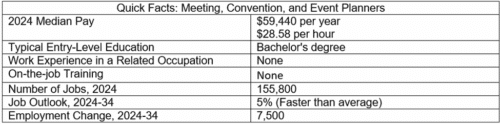
- “Pay: The median annual wage for meeting, convention, and event planners was $59,440 in May 2024.
- Work Environment: Meeting, convention, and event planners work in their offices and onsite at hotels or conference centers. They often travel to attend events and visit meeting sites. During meetings or conventions, planners may work many more hours than usual.
- Job Outlook: Meeting, convention, and event planners spend time in their offices and at event locations, such as hotels and convention centers. They may travel regularly to attend the events they organize and to visit meeting sites. The work of meeting, convention, and event planners can be fast paced and demanding. Planners oversee many aspects of an event at the same time and face numerous deadlines, and they may coordinate multiple meetings or events at the same time. Employment of meeting, convention, and event planners is projected to grow 5 percent from 2024 to 2034, faster than the average for all occupations. About 15,500 openings for meeting, convention, and event planners are projected each year, on average, over the decade. Many of those openings are expected to result from the need to replace workers who transfer to different occupations or exit the labor force, such as to retire.”
Additional Small Business Resources
Already in business or thinking about starting your own small business? Check out our various small business resources:
- View more business reports here: Small Business Snapshots
- View small business help topics here: Small Business Information Center
- View industry-specific research here: Market Research Links
- View business plans samples here: Sample Business Plans
Remember, you can also receive free professional business advice and free or low-cost business training from your local Small Business Development Center!
Photo by chuttersnap on Unsplash