
Learn more about the Bookstore industry and find more information on how to open your own Bookstore business. Don’t forget you can receive free or low-cost training and free professional business advice, from your local Small Business Development Center!
View our related business reports here: Coffee Shop Business, Bakery Business
Get a free Bookstore business plan template on our Business Plan page.
Bookstore Business Forecast
The Bookstore Industry is steadily growing and seeing a consistent increase in sales within the past few years, despite previous industry challenges. A recent report from the American Booksellers Association noted that 605 bookstore were opened last year with a notably 21% increase in stores planning to open. This upward trend suggests that growth may continue as more consumers express a desire to engage with books more frequently. Additionally, more consumers are also gravitating to in-person shopping and choosing physical books, driven by a desire for community and meaningful experiences. As a result, independent bookstores are uniquely positioned to benefit from this shift, especially those that emphasize local engagement.
Looking ahead, the outlook for independent bookstores is becoming increasingly promising as consumer habits evolve. More shoppers are seeking places where they can linger, connect, and explore, rather than simply purchase a book. As a result, bookstores that offer curated collections, author events, book clubs, and a genuine sense of belonging can build deeper loyalty. In addition, fostering community engagement helps strengthen relationships with readers and creates memorable experiences that larger retailers often cannot replicate. Another way to increase customer engagement is by expanding beyond traditional book sales; offering items such as stationery, gift cards, or even establishing a coffee shop presence can diversity revenue. Altogether, bookstores are evolving into vibrant hubs where recreation and leisure meet discovery and connection.
Here are some additional business resources specific to the industry:
- American Booksellers Association – Resource List
- Independent Book Publishers Association – Resources
- Midwest Independent Booksellers Association – Industry Resources
- Great Lakes Independent Booksellers Association – Tools of the Trade
- Professional Booksellers School – Tools & Resources
Bookstore Business Overview & Trends
NAICS Code: 459210; SIC Code: 5942
Bookstores are an important segment of the U.S. Retail Trade industry with a large impact on the U.S. Economy. Physical book sales are steadily climbing with unit sales rising to 782.7 million in recent years.
This bookstore industry summary is from First Research which also sells a full version of this report.
- “Companies in this industry sell books from physical retail locations; they may also sell via websites. Major companies include Barnes & Noble, Books-A-Million, and Follett (all based in the US), as well as Fnac Darty (France), Indigo Books & Music (Canada), Kinokuniya (Japan), Thalia (Germany), and Waterstones and WHSmith (both based in the UK).
- The global book market is valued at nearly $95 billion in 2025 and is expected to reach $100 billion by 2029, according to Statista. The US, China, Germany, Japan, and India are some of the top countries in terms of book sales.
- The US bookstores industry includes about 6,500 establishments (single-location companies and units of multi-location companies) with combined annual revenue of about $10 billion.
- Competitive Landscape: The potential long-term effects to bookstores as a result of the coronavirus outbreak may be severe. Store closures and social distancing by consumers will drive sales lost to online booksellers, notably Amazon, which the industry has been battling for decades. Already suffering year-over-year declines in sales, COVID-19 is likely to accelerate sales declines at bookstores. However, the global book market is expected to recover after a decrease in sales from 2019 to 2020. The market is expected to reach about $95 billion in 2025, according to Statista.”
Bookstore Technology
Technology is an increasingly vital component of the retail trade industry. Tools such as digital loyalty programs and offering ebooks or audio books are being actively adopted across bookstores. These innovations enhance consumer experiences, whether in a brick-and-mortar or online bookstore. Here is information on technology usage in bookstores:
- Retail Trends – discusses how retail stores are utilizing technology to enhance business.
- Technology Outlook – notable AI trends enhancing companies.
- Social Media Algorithms – social media effect on bookstore sales.
For additional information on technology, visit our AI for Small Business Guide.
Bookstore Customer Demographics
Major customer segments for Bookstores are reported by IBISWorld which offers a full version of this report for purchase here.
- The Bookstores market is segmented by industry revenue.
- Consumers between the ages of 25 and 44 are the largest contributors to industry revenue at 34.0%. This is largely due to steadier incomes that allow for more frequent and expensive book purchases. Many consumers in this category are also parents which drives strong growth for spending on children’s books.
- Following closely behind are consumers between the ages of 45 and 64, who account for 28.9% of industry revenue. This is due to higher and more stable incomes allowing for significant spending on books for their family.
- Consumers 65 and over account for 25.6% of industry revenue due to increased interest in activities like reading to fill up leisure time, with fixed incomes that require careful selection when purchasing books.
- Consumers under 25 represent the smallest percentage of industry revenue at 11.5%. This is due to a restricted disposable income, since many of these consumers are grappling with other life expenses that take priority over books. Still, their heavy engagement with social media means trending titles often capture their attention. When they do buy, this group tends to favor used books and online sources rather than traditional brick‑and‑mortar stores.
Additional information on bookstore demographics can be found in a variety of publications, including:
- Gen Z Is Reading Less – Forbes
- Time Spent Reading – American Academy of Arts & Sciences
- Americans are reading fewer books – NPR
Bookstore Startup Costs
Establishing a bookstore requires an understanding of the startup costs involved in order to develop a sound financial plan. Whether you’re purchasing an existing store or selecting a site to build your own, there are many important costs to consider.
According to a cost breakdown reported by GrowThink, bookstore related costs are as follows:
- “One thing that can really change when considering how to start a bookstore is the amount of money needed in order for the whole process—opening and running—to be successful. The number varies depending on what type of bookstore you want to open.
- The average independent bookstore requires a minimum of $60,000, especially during the first month with all the startup costs involved. This includes expenses such as general liability insurance, shelving, register and counter space for check outs, tables, displays, etc. To track these expenses and incoming revenue, you need to open a business bank account.”
Additional bookstore startup cost information can be found at:
- Book Store Owner – Entrepreneur
- “Startup Costs: $10,000 – $50,000
- Part Time: Can be operated part-time.Franchises Available? No
- Online Operation? No”
- How Much Would It Cost to Start a Bookstore and Where to Get Money to Start? – Friends of the Houston Public Library
- “First month’s rent and utilities – $2,000
- Fixtures – $4,000
- Inventory control system – $7,000
- External and internal signage and furnishings – $5,000
- Logo and business cards – $500
- Buildout – $500
- Grand opening promotion – $1,000
- One month’s operating expenses – $3,000
- Combining all these items, you’re looking at first-month expenses of around $23,000 minimum to open a small independent bookstore.”
Bookstore Business Plans
The following are sample bookstore business plans for reference. For additional business plan samples, visit our Business Plan Guide.
- Used Book Store Business Plan – LivePlan
- Bookstore Business Plan Template – Growthink
- Bookstore Business Plan Template – PlanBuildr
- Online Book Store Business Plan – Profitable Venture (1)
- Retail Store Business Plan – Profitable Venture (2)
- Used Book Store Business Plan – TheFinanceResource
Bookstore Associations
Trade associations often are excellent sources of information on an industry. Here are some relevant bookstore industry associations:
- American Booksellers Association (1)
- Independent Online Booksellers Association
- Independent Book Publishers Association
- The Antiquarian Booksellers’ Association of America
- Independent Booksellers Consortium
Bookstore Regulations
The section is intended to provide a general awareness of bookstore regulations and agencies to consider when starting your business. Check with your state and municipality for rules and regulations that may impact the business in your area.
- Employer Identification Number – IRS
- Laws and Regulations – Occupational Safety and Health Administration
- Doing Business As: What It Means to Register a DBA – U.S. Chamber of Commerce
- Opening a Bookstore – American Booksellers Association (2)
- New Beneficial Ownership Information Reporting Requirement – American Booksellers Association (3)
Bookstore Publications & Resources
For resources to help market your book store start up, visit our Digital Marketing Guide, Social Media Marketing Guide, and our Website Design Guide.
Bookstore Employment Trends
Understanding employment trends in your industry is important when opening a bookstore. Bookstores owners rely on a range of roles to operate effectively. This includes retail cashiers and supervisors. The following are insights from the Bureau of Labor Statistics Occupational Outlook Handbook into Retail Sales Workers. A more specific breakdown of other bookstore-related occupations is available from the Bureau of Labor Statistics.
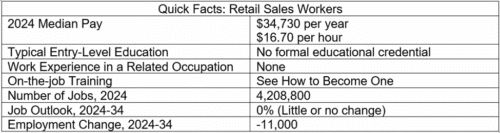
- “Pay: The median hourly wage for parts salespersons was $18.00 in May 2024. The median wage is the wage at which half the workers in an occupation earned more than that amount and half earned less. The lowest 10 percent earned less than $13.35, and the highest 10 percent earned more than $29.69. The median hourly wage for parts salespersons was $18.00 in May 2024. The median hourly wage for retail salespersons was $16.62 in May 2024.
- Work Environment: Most parts salespersons and retail salespersons work in stores. Some workers travel to meet clients or visit other stores. Retail sales workers spend most of their time interacting with customers, such as to answer their questions or assist them with purchases.
- Job Outlook: Overall employment of retail sales workers is projected to show little or no change from 2024 to 2034. Despite limited employment growth, about 586,000 openings for retail sales workers are projected each year, on average, over the decade. Most of those openings are expected to result from the need to replace workers who transfer to different occupations or exit the labor force, such as to retire.”
Additional Small Business Resources
Already in business or thinking about starting your own small business? Check out our various small business resources:
- View more business reports here: Small Business Snapshots
- View small business help topics here: Small Business Information Center
- View industry-specific research here: Market Research Links
- View business plans samples here: Sample Business Plans
Remember, you can also receive free professional business advice and free or low-cost business training from your local Small Business Development Center!
Photo by John Michael Thomas on Unsplash