

Learn about the Self-Storage Industry and find information on how to open a Self-Storage Business. Don’t forget you can receive free or low-cost training and free professional business advice from your local Small Business Development Center!
Get a free Self-Storage business plan template on our Business Plans page.
Self-Storage Business Industry Forecast
The self-storage industry remains resilient and continues to benefit from population growth and other demand drivers. Consumers navigating various life stages consistently turn to self-storage facilities to store personal belongings. Similarly, businesses often utilize self-storage units for excess inventory, while many e-commerce entrepreneurs rely on them as a primary warehousing solution. Although demand has remained steady for years, some markets are experiencing an oversupply of facilities developed in response to the industry’s previous market conditions. In addition, independent storage operators face increased competition from national franchises that benefit from larger marketing budgets and stronger brand recognition. To remain competitive, smaller operators may need to carefully evaluate selecting a site and leverage digital marketing strategies to reach customers seeking storage solutions.
Looking ahead, several key trends may shape the future of the self-storage industry. As consumers expectations evolve, more facilities are embracing seamless digital experiences through online leasing, automated payments, and mobile account management. Continued technology adoption will help operators strengthen security and improve the overall customer experience. In some markets, owners may also explore opportunities to diversity by offering RV, boat, and vehicle storage. Overall, the industry’s outlook remains positive, as self-storage operators continue to adapt to consumers’ needs while benefiting from recurring demand for their services.
Here are some additional business resources specific to the industry:
- Self-Storage Association – Legal Resource Center
- Modern Storage Media – Buyer’s Guide
- Inside Self-Storage – Facility Operators Industry News
Self-Storage Business Industry Overview & Trends
NAICS Code: 531130; SIC Code: 4225
The following Self-Storage Industry summary is from First Research, which also sells a full version of this report.
- “Companies in this industry rent or lease locations for self-storage, providing secure space (such as rooms, compartments, lockers, containers, or outdoor space) where clients can store and retrieve their goods. Major companies include REITs such as CubeSmart, Extra Space Storage, and Public Storage (all based in the US), along with Dymon Storage (Canada), Safestore (UK), and Shurgard (Belgium). The global self-storage market size was valued at $60 billion in 2023 and is expected to reach about $83 billion by 2030, according to Grand View Research. The US remains one of the most established self-storage markets, followed by the EU, with growing demand due to increased urbanization. The US self-storage services industry consists of about 16,000 establishments (single-location companies and units of multi-location companies) with about $12 billion in annual revenue.
- Competitive Landscape: Demand for self-storage services is driven by population growth and consumer spending. The profitability of individual companies depends on marketing and pricing. Large companies enjoy economies of scale in administration, marketing, and purchasing and are often better able to finance acquisitions. Small companies can compete by specializing in local markets or by offering niche services. The US industry is concentrated: the 50 largest companies generate about 60% of revenue.
- Products, Operations & Technology: Major services consist of providing units of varying sizes for storage of customers’ personal or business belongings (97% of industry revenue). A growing number of storage units are climate-controlled. Many companies provide storage space for large items such as cars, boats, and RVs”
Self-Storage Technology
Technology continues to reshape the self-storage industry, with customers increasingly expecting convenient digital services and modern storage features. High-demand amenities include automated and self-service options and climate-controlled storage units. Here is information on technology usage in the self-storage industry:
- Technology Remaking the Self-Storage Industry in 2026 – Inside Self-Storage (1)
- What Self-Storage Operators Should Do Differently in 2026 – Storable (1)
- Innovations Transforming the Industry – Modern Storage Magazine
- Key Benefits and Features of Today’s Self-Storage Software – Inside Self-Storage (2)
For additional information on technology, visit our AI for Small Business Guide.
Self-Storage Business Customer Demographics
Major customer segments for Storage & Warehouse Leasing are reported by IBISWorld, which offers a full version of the report for purchase here.
- The Storage & Warehouse Leasing market is segmented by key markets.
- Residential customers make up a combined 75% of the market. While this group is divided between long- and short-term, the main reasons for their demand are significant lifestyle changes such as relationships, relocation due to new jobs, retirement, or new home ownership.
- The next group in the market is commercial operators. Sitting at 18.7% of the market, this group often uses storage units to house seasonal items, inventory, or equipment. Often, these B2B interactions involve discounts that help maintain demand from this market.
- Students and Military consumers contribute the least to the storage unit market at 3.2% and 3.1%. Students’ demand is often seasonal, as they seek solutions to store their items for the semester breaks. As for the military, they often have longer leases due to the need to relocate and move elsewhere for a longer period.
Additional information on self-storage demographics can also be found in a variety of additional resources including:
- Self-Storage Demand Study – Self-Storage Association
- Keeping Your Marketing on Target with Self-Storage Personas – Storable (2)
- Self-Storage Sector Review – Inland Investment
Self-Storage Business Startup Costs
Establishing a self-storage requires an understanding of the startup costs involved in order to develop a sound financial plan. Whether you’re purchasing an existing store or selecting a site to build your own facility, there are many important costs to consider.
According to a cost breakdown reported by Profitable Venture, mini self-storage unit related costs are as follows:
“Operating Costs
- According to The Self-Storage Expense Guidebook, operating costs for storage units average $3.78 per square foot. Reports give the range for operating expenses as about $2.75 to $3.25 per square foot, with the numbers varying due to salary costs in different markets. Operating costs will also increase if the units are climate-controlled.
Additional cost factors
- Poured concrete foundation ranges from $4 to $7 per square foot.
- Labor costs vary according to location and average salaries in your area but average between $2 and $6 per square foot.
- Insulation ranges from around $0.40 to $2 per square foot, depending on the type.
- Customization and add-ons increase the price of your steel storage building. Popular options include solar panels, windows, skylights, vehicle and walk doors, and finishing options such as stucco and brick.”
Additional self-storage business startup cost information can be found at:
How to Build a Self-Storage Business – Chron
- “Write a detailed business plan compiling the data into a succinct report that reviews your concept, property costs and construction estimates. Also create revenue estimates based demonstrate a timeline on recuperating investment costs.
- Fund the venture with personal cash, private investors or a small business loan from a local bank. Provide investors and lenders a copy of the business plan showing your idea and professionalism. Although you don’t need a business plan if you are personally financing the facility, the plan helps keep you on track and budget.”
Self-Storage Business Plans
The following are sample self-storage business plans for reference. For additional business plan samples, visit our Business Plan Guide.
- Self-Storage Business Plan – LivePlan
- Self-Storage Business Plan Template – Growthink
- Self-Storage Unit Business Plan Template – Profitable Ventures
- Boat Storage Business Plan Template – The Finance Resource
Self-Storage Business Associations
Trade associations often are excellent sources of information on an industry. Here are some relevant self-storage industry associations:
- Self Storage Association (SSA)
- SSA Chartered, Managed and Affiliated National and International Associations
- National Association of Residential Property Managers
Self-Storage Business Regulations
The section is intended to provide a general awareness of bookstore regulations and agencies to consider when starting your business. Check with your state and municipality for rules and regulations that may impact the business in your area.
While there seems to be no federal agency regulating the industry, self-storage facilities must operate in compliance with zoning regulations, building codes, and other ordinances at the local level.
- Employer Identification Number – IRS
- Laws and Regulations – Occupational Safety and Health Administration
- Doing Business As: What It Means to Register a DBA – U.S. Chamber of Commerce
Self-Storage Publications
For resources to help market your drone business start up, visit our Digital Marketing Guide, Social Media Marketing Guide, and our Website Design Guide.
Self-Storage Business Employment Trends
Understanding employment trends within the service sector is essential when opening a self-storage business. These businesses depend on a variety of specialized support roles to operate smoothly, including facilities managers, counter and rental clerks, and other staff for operations. The following are insights from the Bureau of Labor Statistics Occupational Outlook Handbook into Administrative Services and Facilities Managers. A more specific breakdown of other storage related business occupations is available from the Bureau of Labor Statistics.
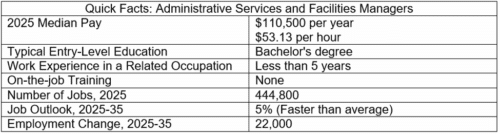
- “Pay: The median annual wage for administrative services managers was $114,130 in May 2025. The median wage is the wage at which half the workers in an occupation earned more than that amount and half earned less. The lowest 10 percent earned less than $67,100, and the highest 10 percent earned more than $207,720. The median annual wage for facilities managers was $106,660 in May 2025. The lowest 10 percent earned less than $64,480, and the highest 10 percent earned more than $176,120.
- Work Environment: Administrative services and facilities managers spend much of their day in an office. They may observe workers throughout the building, go outdoors to supervise groundskeeping activities, or visit other facilities they direct.
- Job Outlook: Overall employment of administrative services and facilities managers is projected to grow 5 percent from 2025 to 2035, faster than the average for all occupations. About 36,100 openings for administrative services and facilities managers are projected each year, on average, over the decade. Many of those openings are expected to result from the need to replace workers who transfer to different occupations or exit the labor force, such as to retire.”
Additional Small Business Resources
Already in business or thinking about starting your own small business? Check out our various small business resources:
- View more business reports here: Small Business Snapshots
- View small business help topics here: Small Business Information Center
- View industry-specific research here: Market Research Links
- View business plans samples here: Sample Business Plans
- View our small business cybersecurity resources here: Small Business Cybersecurity
Remember, you can also receive free professional business advice and free or low-cost business training from your local Small Business Development Center!
Photo by Joshua Coleman on Unsplash