

Learn about the Fast food restaurant industry and find information on how to open your own Fast Food restaurant. Don’t forget you can receive free or low-cost training and free professional business advice, from your local Small Business Development Center!
View our related business reports here: Full Service Restaurant Business, Food Truck Business and Bar Business, and Food Service Industry Research.
Get a Fast Food business plan template on our Business Plans page.
Fast Food Restaurant Business Forecast
The fast food restaurant industry is evolving to meet consumer demands for affordability and value. Overall sales at limited-service restaurants continue to rise, with food sales reaching $516.1 billion this past year. As a result, fast food remains an important part of the food service industry by providing speed and convenience. However, rising ingredient costs have led many operators to increase menu prices, causing some consumers to view fast food as more of a luxury than an everyday option. Consequently, operators are placing greater emphasis on value meals while maintaining a steady flow of promotion and discounts. As household budgets tighten and consumers become increasingly price-conscious, highlighting value and affordability may help reinforce the role of fast food restaurants within the broader food service industry.
Looking ahead, fast food operators are also leveraging technology to create a more seamless digital dining experience. For example, digital ordering kiosks, AI-assisted drive through systems, and automated fryers are being adopted to deliver the modern conveniences consumers increasingly expect. At the same time, restaurants continue to manage rising food costs by seeking alternative suppliers and, in some cases, removing menu items altogether. While these challenges present operational hurdles, they also create opportunities for fast food establishments to reevaluate their offerings and strengthen their value proposition.
Here are some additional business resources specific to the industry:
- National Restaurant Association – Education & Resources
- The Food Industry Association – Directories
- International Foodservice Manufacturers Association – Resources
Fast Food Restaurant Business Overview & Trends
NAICS Code: 722513, SIC Code: 5812
Fast Food establishments are an impactful segment of the U.S. food services industry. In recent years food service sales have increased to $2.51 trillion and are expected to continue to increase as food away from home spending continues.
The following Fast Food and Quick service restaurant industry summary report is from First Research which also sells a full version of this report.
- “Companies in this industry operate restaurants in which customers order and pay at a counter. Major companies include Chipotle, McDonald’s, Wendy’s, and Yum Brands (all based in the US), as well as Café de Coral (Hong Kong), Greggs (UK), Restaurant Brands International (Canada), and Seven & i Food Systems (Japan).
- The global fast-food market is forecast to reach about $1.5 trillion by 2032 at a CAGR of about 6% during the 2022-2032 period, according to Spherical Insights. Consumer food service sales are expected to grow most rapidly in Latin America, the Middle East/Africa region, and the Asia/Pacific region.”
This Limited Food service business market insights is from Euromonitor, which also sells a full version of this report.
- The U.S. limited-service restaurant market reached 492.2 billion in 2025; this is driven by high inflation and menu prices. Actual transaction volumes remain low due to lower amounts of discretionary spending from lower income consumers.
- Fulfillment habits are shifting from traditional channels towards advanced digital ordering and seamless pickup spaces. While traditional drive-thru lanes face heavy wait times, this gives opportunity for dedicated mobile order/to go pickup spots.
- This sector is projected to reach 556.4 billion by 2030, outpacing the growth of full-service restaurants. However, fast-food chains face competition from supermarkets, grocery stores, and delis that provide prepared meals.
Fast Food Restaurant Technology
Technology is reshaping business operations in the fast-food industry. As seen in other industries, the rise of automation through artificial intelligence has become a major factor shaping business operations, and fast-food restaurants are no exception. Food operators are increasingly using AI to reduce customer wait time and improve consistence in food quality. Here is information on technology usage in fast-food restaurants:
- Ways AI Will Impact Restaurants – The Food Institute
- Lowering costs and improving customer satisfaction – Bank of American Institute
- How restaurants are tapping technology to cultivate the customer journey – Restaurant Business
- Frontline Human Capital Trends in Restaurants – Deloitte
For additional information on technology, visit our AI for Small Business Guide.
Quick Service Restaurant Customer Demographics
Major customer segments for Fast Food Restaurants are reported by IBISWorld, which offers full version of the report for purchase here.
- Fast-Food restaurant industry is segmented by household income.
- Households earning greater than $100,000 have large amounts of disposable income and make up 53.3% of the market. However, they usually prefer more formal or full-service restaurants when eating out since their budget allows splurging on upscale dinning experiences.
- Households earning between $50,000 and $99,999 comprise 20.4% of industry revenue. As fast food restaurants expand their menu offerings with healthier alternatives, they became more popular with middle-income group.
- Households earning less than $50,000 represent the remaining 26.2% of the market. Smaller amounts of discretionary income limit their ability to eat away from home, but fast food’s lower price point means they are usually go-to restaurants when possible. Often households earning below $50,000 receive snap benefits which limit their ability to spend on non-grocery meals.
Additional information on fast food customers demographics can be found in a variety of trade associations and publications, including:
- How Much Boomers Actually Spend on Fast Food – Tasting Table
- Health-Conscious Consumer Statistics – Capital One Shopping Research
- Generational Fast-Food Visits – The Takeout
Fast Food Restaurant Business Startup Costs
When opening a fast-food restaurant operators must be aware of all the startup costs involved in order to develop a sound financial plan. Many fast-food franchises have their own startup fee structures and equipment requirements. Be sure to consult with the franchisor to understand required investment and ongoing fees.
According to a cost breakdown reported by GrowThink, fast food startup costs are as follows:
“To provide a comprehensive summary, let’s tally up the low and high end of the cost estimates for starting a fast food restaurant.
Capital Investments:
- Real Estate Costs: $10,000 – $45,000 (initial deposit and first month’s rent)
- Construction and Renovation: $155,000 – $465,000
- Kitchen Equipment: $30,000 – $90,000
- Technology: $18,000 – $50,000
- Initial Inventory: $15,000 – $30,000
- Working Capital: $50,000 – $100,000
- Total Capital Investments: $278,000 – $780,000”
- “Overall Costs: $375,500 – total, $3,586 – cost per seat, $113 – cost per sq. ft.
- Limited-Service Costs: $225,500 – total, $4,510 – cost per seat, $121 – cost per sq. ft.”
Additional fast food restaurant startup costs information can be found at:
- How to Open a Fast Food Restaurant – Toast
- “Understand Your Finances and Operating Expenses
- Start by calculating how much it will cost you to open up your fast food restaurant and exploring how to finance your endeavor. Some entrepreneurs prefer more institutional financing options, like loans, cash advances, and lines of credit, while others start with crowdfunding, friends and family fundraising. Take your time figuring out what works best for your and your business needs.”
- “Understand Your Finances and Operating Expenses
- A List of Expenses for Starting a Restaurant From Scratch – Chron
- “Food costs depend on your restaurant concept; fast-food establishments will naturally have lower initial food costs than a luxury restaurant. That said, you can expect to spend around $5,000 to $25,000 on your initial food and beverage order (including alcohol) when starting a casual-themed restaurant.”
Fast Food Restaurant Business Plans
The following are sample Fast Food Restaurant Business Plans for reference. For additional business plan samples, visit our Business Plans page.
- Fast Food Service Business Plan – LivePlan
- Franchised Restaurant Business Plan – The Finance Resource
- Fast Food Restaurant Business Plan – Profitable Venture (1)
- Fast Food Business Plan Template – Growthink
- Quick Service Restaurant Business Plan – Profitable Venture (2)
Fast Food Restaurant Business Associations
Trade associations often are excellent sources of information on an industry. Here are some relevant fast food restaurant industry associations:
- Council of State Restaurant Associations
- Fast Casual Industry Council
- Green Restaurant Association
- National Restaurant Association
- State Restaurant Associations – select state from drop down
Quick Service Restaurant Business Regulations
The section is intended to provide a general awareness of fast-food restaurant regulations and agencies to consider when starting a fast-food restaurant business. Check with your state and municipality for rules and regulations that may impact the business in your area. Most regulations are administered at the state and local levels and relate to food safety, health permits, or food handlers.
Fast-food restaurants are commonly required to comply with local health department regulations based on the FDA Food Code, which establishes standards for food handling, storage, and employee hygiene. Because requirements vary by location, it is important to verify all applicable permits, licenses, and health regulations before opening and throughout the operation of the business.
- Food Safety Best Practices for Human Food – U.S. Food & Drug Administration (1)
- Menu Labeling Requirements – U.S. Food & Drug Administration (2)
- Restaurant Worker Safety – U.S. Occupational Safety and Health Administration
- State Retail and Food Service Codes and Regulations by State – U.S. Food & Drug Administration (3)
Fast Food Restaurant Business Publications
- Fast Casual
- Food Network Magazine
- eRestaurant Business
- Modern Restaurant Management
- Nation’s Restaurant News
- QSR Magazine
For resources to help market your fast food business start up, visit our Digital Marketing Guide, Social Media Marketing Guide, and our Website Design Guide.
Quick Service Restaurant Business Employment Trends
Understanding employment trends within the food service industry is important when operating a fast-food restaurant. Restaurant owners rely on a range of roles to operate effectively. This includes cooks, cashiers, and maintenance employees. The following are insights from the Bureau of Labor Statistics Occupational Outlook Handbook into Food and Beverage Serving and Related Workers. A more specific breakdown of other food preparation and serving occupations is available from the Bureau of Labor Statistics.
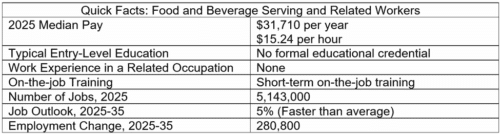
- “Pay: The median hourly wage for food and beverage serving and related workers was $15.24 in May 2025. The median wage is the wage at which half the workers in an occupation earned more than that amount and half earned less. The lowest 10 percent earned less than $10.98, and the highest 10 percent earned more than $20.67.
- Work Environment: Food and beverage serving and related workers spend most of their shift on their feet. They carry trays of food, dishes, or glassware, which are often heavy. During busy dining periods, they are under pressure to serve customers quickly and efficiently.
- Job Outlook: Overall employment of food and beverage serving and related workers is projected to grow 5 percent from 2025 to 2035, faster than the average for all occupations. About 1,078,500 openings for food and beverage serving and related workers are projected each year, on average, over the decade. Many of those openings are expected to result from the need to replace workers who transfer to different occupations or exit the labor force, such as to retire.”
Additional Resources
Already in business or thinking about starting your own small business? Check out our various small business resources:
- View more business reports here: Small Business Snapshots
- View small business help topics here: Small Business Information Center
- View industry-specific research here: Market Research Links
- View our small business cybersecurity resources here: Cybersecurity
Remember, you can also receive free professional business advice and free or low-cost business training from your local Small Business Development Center!
Photo by Sander Dalhuisen on Unsplash