
Learn more about the Bakery Industry and find information on how to open your own retail bakery business. Don’t forget you can receive free or low-cost training and free professional business advice, from your local Small Business Development Center!
View our related business reports here: Food Manufacturing Industry Resources, Food Service Industry Resources, Coffee Shop Business, Bookstore Business
Get a free Bakery business plan template on our Business Plans page.
Retail Bakery Business Forecast
The retail bakery industry is growing and adapting to evolving consumer preferences. As health and wellness become bigger priorities among shoppers, the industry has responded with protein‑enriched baking and a wider use of plant‑based ingredients. Bakers are remaining resilient while meeting these demands, even as they face obstacles like rising material costs. Essential ingredients such as eggs, wheat, and grain continue to increase in price, putting financial strain on bakeries of all sizes. Responding to high‑protein and gluten‑free demand adds another layer of difficulty, as these specialty ingredients are even more expensive. Recent tariff increases have added additional pressure by raising the cost of imported ingredients and equipment that many bakeries rely on. These tariffs can disrupt supply chains and force bakeries to absorb higher expenses or pass them on to consumers, further complicating an already challenging operating environment.
Looking ahead, bakeries are finding creative ways to innovate and diversify their offerings. Many are reimagining nostalgic flavors and transforming them into modern treats that blend comfort with novelty. At the same time, sustainability is becoming a central consideration, prompting bakeries to prioritize locally sourced ingredients, and adopt more eco‑friendly packaging to align with consumers’ values. Additionally, technology is playing a growing role in the industry, from automated production systems to digital ordering platforms that assist operations and enhance the customer experience. Overall, the outlook for the bakery industry remains optimistic, with businesses continuing to evolve in ways that balance tradition with innovation.
Here are some additional business resources specific to the industry:
- American Society of Baking – National Bakery Associations & Resources
- Retail Bakers of America – Industry Resources
- Craft to Crumb – Craft to Crumb Industry Resources
- The Bakery Network – Resources
Retail Bakery Business Industry Overview & Trends
NAICS Code: 311811, SIC Code: 5461
This Bakery Product Manufacturing industry summary is from First Research which also sells a full version of this report.
- “Companies in this industry make fresh and frozen bread as well as cakes, pies, and doughnuts. Major companies include Dawn Foods, Flowers Foods, Franz Bakery, and McKee Foods (all based in the US), along with Allied Bakeries (UK), ARYZTA (Switzerland), Grupo Bimbo (Mexico), Weston Foods (Canada), and Yamazaki Baking (Japan).
- Because of the perishable nature of bakery products, international trade does not play a major role in the industry. However, disruptions in grain production and trade can have significant eects on global supplies and prices of ingredients. Canada is by far the US’ largest trading partner for both imports and exports of bakery products, followed by Mexico, according to the Observatory of Economic Complexity (OEC).
- The US bakery products industry includes about 10,000 establishments with a combined annual revenue of about $43 billion.
- Competitive Landscape: Demand is driven by consumer preferences and by the extent to which grocery stores choose to operate their own bakeries rather than buy from commercial bakeries. Profitability for individual companies is determined by efficiency of operations. Large companies have scale advantages in procurement, production, and distribution. Small companies can compete by offering specialty goods or superior local distribution services. In the US, the industry is concentrated: the 50 largest companies generate about 60% of revenue.”
These baked goods business market insights are derived from Euromonitor, which also sells a full version of this report.
- Items consumers view as nonessential treats will see fewer impulse purchases. Short shelf lives will reduce their appeal since cost-conscious shoppers are looking for better value.
- Baked goods sales are remaining stable, but economic pressures and price increases are restricting growth. Consumers are shifting towards affordable baked goods and smaller pack sizes, while cutting out indulgent treats such as cakes.
- More brands are introducing protein‑enhanced formulas and highlighting nutritional value. This reflects a growing consumer desire for baked goods that not only taste good but also help support broader fitness or wellness goals.
Retail Bakery Business Technology
Technology is becoming an increasingly vital component of the retail food industry. Tools such as guest-facing POS systems, and mobile ordering are being widely adopted across retail bakeries. These innovations help create an easy and seamless experience for consumers whether it be in person or online. Here is information on technology usage in retail bakeries:
- Automation Adoption – automation trends easing labor needs.
- Tech Transformation – explores how technology is helping scale production.
- Automation & Robotics – discusses the future of automation and robotics in the industry.
- Equipment – covers pros and cons of purchasing new advanced equipment.
For additional information on technology, visit our AI for Small Business Guide.
Retail Bakery Business Customer Demographics
Consumers of all ages and backgrounds continue to indulge in sweet treats, whether purchased from bakeries or made at home. Sweet snacking continues to grow in popularity, with younger consumers increasingly embracing the “little treat” trend. In response, bakeries are expanding their grab-and-go dessert offerings to meet demand. A recent study found that chocolate remains one of the most popular flavors, with 87% of consumers selecting it as their go-to choice when trying new desserts.
Major customer segments for Bakery Cafes are reported by IBISWorld. The full version of the report is available for purchase here.
- The Bakery market is segmented by industry revenue.
- The highest income quintile is the largest contributor at 27.9% of industry revenue. Affluent bakery‑café customers tend to spend more and choose premium, health‑focused items because their higher incomes give them the flexibility to prioritize quality. Many also purchase specialty baked goods for events, making them a consistently reliable segment for cafés.
- The second, third, and fourth income quintiles make up the largest percentage of industry revenue at 50.6% combined. Their purchases of middle-of-the-road products fuel the industry as opposed to high-end delicacies. Since this segments lifestyle does not allow for them to bake at home they often rely on bakeries.
- Businesses and government contribute 11.3% of industry revenue by offering food as a benefit to their employees. Return-to-office initiatives have increased these segments spending at bakery cafes, however, sustained revenue from this segment will rely on government spending and business vitality.
- The lowest-income quintile contributes the least to industry revenue at 10.2%. Due to high inflation, they frequently turn to cheaper alternatives and are more likely to opt for homemade delicacies.
Consumer insights for In-Store Bakeries are reported by Mintel. The report is available for purchase.
- 37% of Gen-Z prefer healthier bakery alternatives to traditional desserts.
- 41% of households with four members prefer healthier baked goods.
- 36% of Millennials prefer baked goods inspired by international bakeries.
- 45% of Gen-X opts for variety pack desserts.
Additional information on bakery demographics can be found in a variety of trade associations and publications, including:
- Bakery sales sway amid demographic, economic undercurrents – Baking Business (1)
- Snack and bakery demand climbs as consumers balance health and indulgence – Food Navigator
- Dive into the latest demographics on cake consumption – Baking Business (2)
Retail Bakery Startup Costs
Establishing a retail bakery requires an understanding of the startup costs involved in order to develop a sound financial plan. Whether you’re purchasing an existing bakery or selecting a site to build your own, there are many important costs to consider.
According to a cost breakdown from Profitable Venture, bakery startup costs are as follows:
- “You will need an estimate of seven hundred thousand Dollars ($700,000) to successfully set up a medium scale but standard bakery business in the United States of America. Please note that this amount includes the salaries of all the staff for the first 3 months of operation.”
Additional bakery startup cost information can be found at:
- Bakery Startup Costs from Entrepreneur
- “Startup Costs: $10,000 – $50,000
- Franchises Available? Yes
- Online Operation? No”
- A Guide to Bakery Business Startup Costs from GrowThink
- “Location and Real Estate: varies
- Store Build Out and Renovations: $10,000 – $100,000
- Bakery Equipment and Machinery: $20,000 – $100,000
- Furniture and Display Cases: $5,000 – $20,000
- Kitchen and Baking Supplies: $5,000 – $15,000”
Retail Bakery Business Plans
The following are sample bakery business plans for reference. For additional business plan samples, visit our Business Plans Guide.
- Dessert Bakery Business Plan – Bplan
- Bakery Business Plan – Profitable Venture
- Bakery Business Plan Template – Business Plan Template
- Baker Business Plan – Toast
- Specialty Baker Business Plan – LivePlan
Retail Bakery Business Associations
Trade associations often are excellent sources of information on an industry. Here are some relevant bakery industry associations:
- Retail Bakers of America
- American Bakers Association
- American Society of Baking
- American Culinary Federation
- Home Baking Association
- International Dairy Deli Bakery Association
- Cookie & Snack Bakers Association
- Retail Bakers of America
Retail Bakery-Related Business Regulations
The section provides a general awareness of regulations and agencies to consider when starting a bakery. Check with your state and municipality for rules and regulations that may impact the business in your area. Operations working out of the home should follow state or local regulations for the cottage food industry. Federal oversight largely centers on broad food safety, labor, and workplace safety standards:
- Bakery Equipment – Occupational Safety and Health Standards
- How to Start a Food Business – U.S. Food & Drug Administration (1)
- Food Code – U.S. Food & Drug Administration (2)
- Food Allergen Labeling and Consumer Protection – U.S. Food & Drug Administration (3)
- Wages and the Fair Labor Standards Act – U.S. Department of Labor
Retail Bakery Business Publications & Resources
- Baking Business
- American Cake Decorating Magazine
- Bakers Journal
- Bake Magazine
- Baking From Scratch
- Pastry Arts
- Commercial Baking
- Snack Food & Wholesale Bakery
For resources to help market your bakery start up, visit our Digital Marketing Guide, Social Media Marketing Guide, and our Website Design Guide.
Retail Bakery Business Employment Trends
Understanding trends in your industry is important when opening a bakery. Bakeries rely on a range of roles to operate effectively. This includes bakers, cashiers, and supervisors. The following are insights from the Bureau of Labor Statistics Occupational Outlook Handbook into Bakers. A more specific breakdown of other food preparation and serving related occupations is available from the Bureau of Labor Statistics.
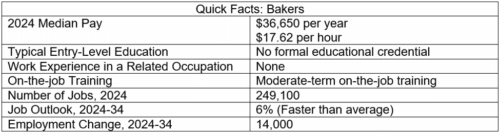
- “Pay: The median annual wage for bakers was $36,650 in May 2024. The median wage is the wage at which half the workers in an occupation earned more than that amount and half earned less. The lowest 10 percent earned less than $27,560, and the highest 10 percent earned more than $48,260.
- Work Environment: Most bakers work in retail or commercial bakeries (manufacturing facilities), grocery stores or wholesale club stores, and restaurants. Work shifts often include early mornings, nights, weekends, and holidays.
- Job Outlook: Employment of bakers is projected to grow 6 percent from 2024 to 2034, faster than the average for all occupations. About 39,900 openings for bakers are projected each year, on average, over the decade. Many of those openings are expected to result from the need to replace workers who transfer to different occupations or exit the labor force, such as to retire.”
Additional Small Business Resources
Already in business or thinking about starting your own small business? Check out our various small business resources:
- View more business reports here: Small Business Snapshots
- View small business help topics here: Small Business Information Center
- View industry-specific research here: Market Research Links
- View business plans samples here: Sample Business Plans
Remember, you can also receive free professional business advice and free or low-cost business training from your local Small Business Development Center!
Photo by Mink Mingle on Unsplash